How Hand-Poured Candles Are Made: The Studio Process Behind Claudi's Vessels
Discover why hand-pouring candle wax takes skill, timing, and the right vessel—and how it changes what you smell for 40+ hours.
By Claudi·Poured in Mossel Bay, Western Cape
Most people buy a candle without thinking about the 20 minutes between melted wax and a finished vessel. In the Mossel Bay studio, that window matters more than you'd expect. The temperature of the wax, the timing of the pour, the choice of vessel—each decision shapes not just how long the candle burns, but how the scent develops over its life. Hand-pouring isn't a romantic gesture. It's a technical skill that determines whether a candle performs as intended or disappoints after the first hour.
Key Takeaways
- Hand-pouring requires precise temperature control—wax poured too hot cools unevenly; poured too cool and it won't bond with the vessel walls, causing tunnelling and wasting fragrance.
- The vessel itself changes the burn profile—our bamboo jar with its lid preserves scent between burns, while tumblers allow continuous evaporation, each suited to different spaces and rituals.
- Fragrance load and cure time are non-negotiable—Claudi's candles are cured for 48 hours minimum before dispatch, allowing the wax and scent to fully marry for optimal throw.
Understanding the Hand-Pour: Why Temperature and Timing Matter
The candle making process explained simply comes down to chemistry and craft. When wax is heated to around 80–85°C in the studio, it becomes liquid enough to pour cleanly around a wick, but cool enough that it won't vaporise fragrance oil on contact. This window is narrow. Pour it at 90°C and the hot wax can strip volatile top notes—the citrus, the salt spray, the first impression—before the candle even cools. Pour it at 70°C and the wax shrinks as it sets, creating visible gaps between the vessel and the hardened surface. Those gaps trap air, and air means uneven heat distribution when the wick burns.
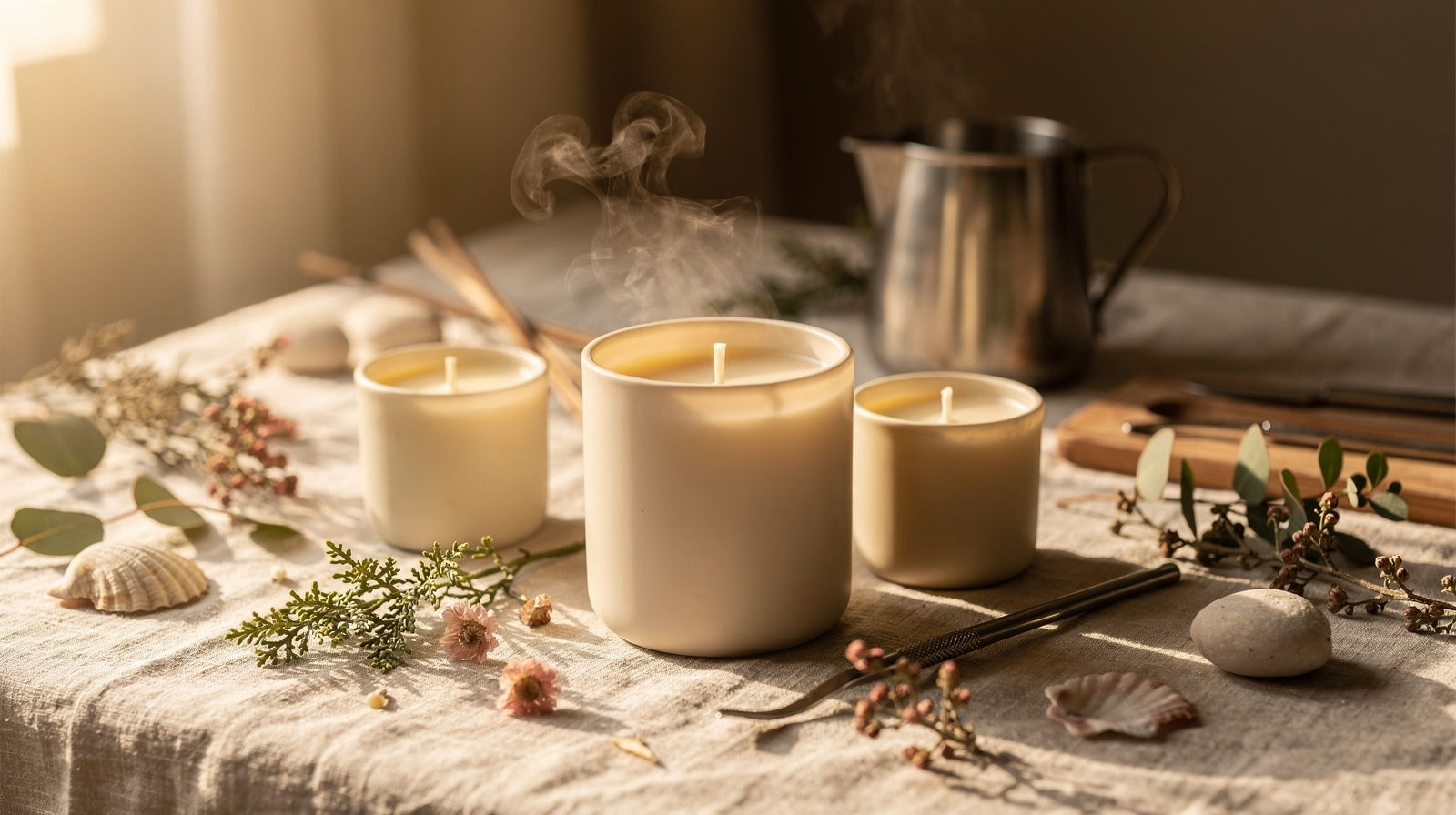
In the Mossel Bay studio, each batch is poured by hand because temperature fluctuates with the day's humidity and the ambient air in the room. A thermometer sits beside every pour. The wick is centred by hand. The wax is moved smoothly, deliberately, around the vessel's interior. This isn't Instagram theatre. It's the difference between a candle that smells like what you paid for and one that smells faint by hour two. After pouring, the candle sits undisturbed for 24 hours, then is moved to the curing room where it stays for another full day before it leaves the studio. This 48-hour cure period allows the fragrance oil to fully integrate with the wax matrix, preventing the scent from fading mid-burn.
Vessel Choice: How the Container Shapes the Experience
The vessel is not decorative—it's functional. Our bamboo jar with its fitted lid creates a sealed microclimate between burns. When you close it, the fragrance molecules remain suspended in the air inside the jar, so when you open it 24 hours later, the scent hits harder. The jar also protects the wax surface from dust and pet hair, and its weight and finish suggest permanence. Once the candle burns down, you keep the vessel. Many people repurpose it as a pen holder or plant pot. The economics favour this design—you're not throwing away a disposable container.
By contrast, tumbler candles have a narrower mouth and thicker walls, which slows the cooling rate and creates a more uniform melt pool when the wick burns. The tumbler is the workhorse of the studio. It burns for 35–45 hours, depending on which scent family you choose. Coastal fragrances, with their volatile marine notes, perform better in tumblers because the narrower opening reduces the rate of evaporation during the burn. The shape becomes the strategy.
Choosing the Right Candle for Your Space: A Practical Framework
Before ordering, ask yourself three questions. First: How long do I want this candle to burn in a single session? If you light it for a morning ritual and prefer to let it run unattended for 3–4 hours, choose a tumbler or pillar candle—both have stable, self-regulating burn profiles. If you light it for 30 minutes in the evening, a bamboo jar makes sense because you can close it and preserve the scent.
Second: What scent appeals to you, and where will it live? A bedroom benefits from Manor fragrances—warm, amber-forward, non-intrusive. A kitchen or open-plan living space suits Coastal or Gather collections because these scents have higher throw and don't overwhelm smaller enclosed spaces. Use our scent quiz to narrow it down if you're uncertain.
Third: Will you keep the vessel after? If yes, prioritise the bamboo jar—it's designed for that second life and looks intentional on a shelf. If you live in a rental or prefer minimalism, a tumbler is the practical choice. The vessel you choose determines not just how the candle performs, but what you do with it when it's finished burning.
Frequently Asked Questions
Why does my hand-poured candle have a sinkhole in the middle after cooling? This happens when wax cools too quickly and contracts unevenly—usually because the room temperature dropped sharply or the candle was moved during the cure period. In the studio, we control this by curing in a stable 20–22°C room with no air movement. If you experience this at home, it doesn't affect burn safety, but it can create a visual ridge. Avoid placing your new candle in direct sunlight or near an open window for 48 hours after purchase.
How long should I burn a candle in one sitting? Burn until the entire wax surface has liquefied—usually 2–3 hours for a tumbler or bamboo jar. If you blow it out before the melt pool reaches the edges, the candle will tunnel on subsequent burns, wasting fragrance and shortening its life. Our candle safety guide walks through this in detail.
What's the difference between a hand-poured candle and a machine-made one? Machine-made candles cool in moulds under controlled pressure, creating uniform density but sacrificing fragrance integration. Hand-poured candles cool naturally, allowing the wax and scent to bond more thoroughly. The trade-off is variation—no two hand-poured candles are identical. In the Mossel Bay studio, that variation is intentional. It's the mark of something made by a person, not a line.
Can I personalise a candle as a gift? Yes. Our custom label builder lets you add a name, date, or message to any tumbler or bamboo jar. Labels are printed and applied in-studio before dispatch, so you can gift something that feels entirely yours. Lead time is 5–7 business days for custom orders.
The Studio Difference
The candle making process explained through industrial efficiency misses the point. Yes, machines pour faster and more consistently. But consistency isn't the goal here—performance is. A candle that smells as intended for its full 40+ hour burn, in the vessel you keep long after the wax is gone, in a scent that suits your space and time of year. That requires attention. It requires someone in the room, checking temperatures, watching the pour, letting time do its work.
When you choose a hand-poured candle from the Mossel Bay studio, you're choosing that labour. You're choosing the bamboo jar that lives on your shelf afterwards, or the tumbler that becomes part of your evening ritual. Start with our scent quiz to find your fragrance family, then order with confidence. The vessel and the process are built to last.
Studio notes, July 2026 — Claudi's Studio, Mossel Bay.