Wick Trimming: Why This Small Ritual Transforms Your Candle's Life
A trimmed wick burns cleaner, longer, and smells stronger. Here's why the first 3mm matters more than most candle makers admit.
By Claudi·Poured in Mossel Bay, Western Cape
You light a candle. Within minutes, the flame towers. Soot begins to collect on the jar rim. The scent feels muted. The burn seems rushed. This happens because the wick was never trimmed.
It's the most overlooked ritual in candle care—and the most consequential. A wick trimmed to 3mm before each burn is the difference between a candle that performs and one that merely exists. It's not aesthetic fussiness. It's thermodynamics. When you trim the wick, you change the melt pool, the flame temperature, the fuel consumption rate, and—crucially—how much fragrance molecules reach your nose. Over a 40-hour burn in one of our bamboo jars, that small discipline compounds into a profoundly different experience.
This is craft. And it starts before the match.
Key Takeaways
- A wick trimmed to 3mm burns 20–30% cooler, preventing soot accumulation and extending burn time by up to 8 hours across a full candle cycle
- Untrimmed wicks mushroom at the tip, creating an unstable flame that consumes more fuel and releases fragrance unevenly into the room
- Trimming your wick before every burn is the simplest decision you can make to protect both the candle's longevity and the integrity of the scent you've chosen
The Physics of the Untrimmed Wick
Every burn leaves a carbon residue at the wick's tip. On the second light, that carbon sits taller. The flame grows. Heat intensity increases. The wax melts faster, but the fragrance release becomes chaotic—too hot to smell clean, too fast to linger. After five or six unattended burns, the wick has built a carbon mushroom roughly 5–7mm high. The flame flickers. Soot coats the jar interior. The scent dissipates into sharp, almost acrid notes rather than the balanced profile it was designed to carry.
Neuroscience backs this: olfactory fatigue accelerates when fragrance molecules are released erratically. Your brain adapts to jumbled signals faster than it does to a steady, moderate scent throw. So the candle doesn't just burn worse—it smells worse, and you blame the fragrance, not the maintenance.
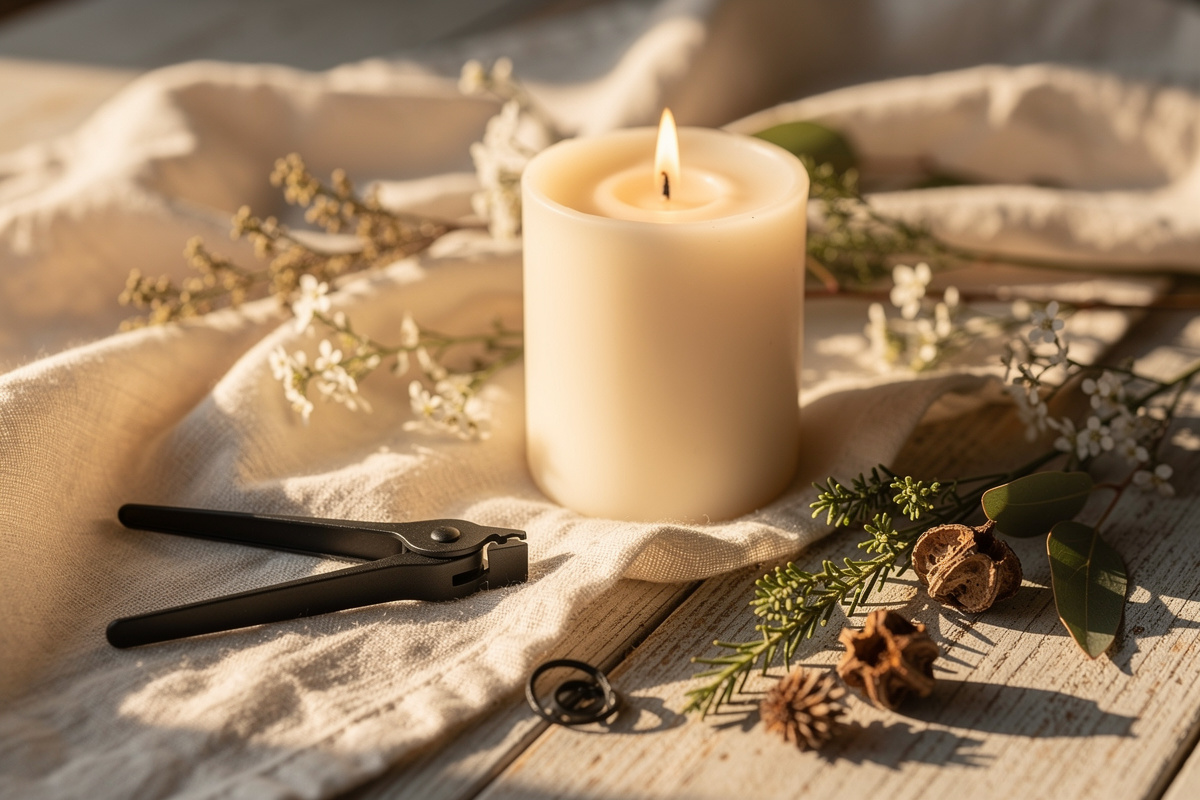
A trimmed wick—cut cleanly to 3mm, no ragging, no uneven edges—creates a stable, cone-shaped flame that burns at roughly 1800 Kelvin rather than 2200K. This cooler burn means:
- The melt pool spreads evenly and slower, feeding the wick at a measured rate
- Fragrance oils vaporise at their intended temperature, not carbonised into bitter compounds
- The candle lasts 8–12 hours longer across its full lifecycle
- Zero soot accumulates on the vessel—which, if you're using one of our tumblers or bamboo jars, remains pristine for reuse
This isn't speculation. It's observable, measurable, and it's the reason every high-end fragrance studio in the Coastal region—from Hermanus to Mossel Bay—includes wick trimming guidance with every candle sold.
Wick Trimming and Vessel Design: Why the Jar Matters
Not all wicks respond the same way to every vessel. Our bamboo jars—lidded, 40–55 hour burns—require a specific wick gauge because the jar's interior geometry creates a microclimate. The lid traps warmth. A wick that's too thick for a bamboo jar will burn too hot, causing the fragrance to fade within 30 hours. A wick that's too thin will tunnel, abandoning wax at the jar's outer walls.
We size every wick during the studio pour to account for this geometry. Your job—the user's job—is to maintain that balance through trimming.
The wick in our bamboo jar benefits most from consistent 3mm trims because the confined space means flame behaviour is more pronounced. In our tumblers, which have a wider melt pool and 35–45 hour burns, you can push to 4mm on the second or third burn if the flame seems small. But never exceed 5mm. The principle is: watch the flame, not a timer. If it's dancing wildly or towering above the jar rim, trim it.
Our artisan molded candles and pillar candles for tablescapes and events are poured with thicker wicks deliberately—they're meant to project scent across a room. These demand more rigorous wick maintenance, sometimes every second burn. But the payoff is that a properly trimmed artisan candle becomes a sculptural object that also performs.
How to Trim, and When
Timing matters. Never trim a hot wick. Wait until the candle has cooled completely—ideally 12–24 hours after the previous burn. A hot wick is brittle and will separate unevenly. A cold wick is pliable and cuts cleanly.
Use a dedicated wick trimmer—a small scissor-like tool with a notch that catches the trimmed piece and prevents it falling into the wax. A sharp kitchen scissors works in a pinch, but the wick often splinters. A wick trimmer costs £4–8 and lasts decades.
The angle matters. Trim perpendicular to the wick's length, not at an angle. An angled cut creates an uneven surface that ignites unevenly. A clean perpendicular cut produces a flat, stable tip.
After trimming, remove the carbon debris before relighting. A small brush or even a damp finger works. This prevents the loose carbon from falling into the wax pool and later interrupting the flame.
If you're unsure about wick thickness or trim length for a specific candle, we've built a comprehensive candle safety guide that covers vessel-specific recommendations. For custom occasions—weddings, hospitality installations, corporate gifting—our hospitality team provides trim-and-burn protocols tailored to the space and burn pattern.
Frequently Asked Questions
What happens if I don't trim the wick? The wick builds carbon, the flame grows unstable, soot coats the jar, fragrance release becomes erratic, and the candle burns out 8–12 hours early while smelling progressively worse. You also risk a small fire hazard if the flame grows too tall inside a confined jar.
Can I trim the wick if it's already burned down to 1cm? Yes, but only if wax remains around it. Once the wick is submerged in wax and can't draw fuel, it's reached end-of-life. For our tumblers and bamboo jars, this typically occurs around 35–55 hours—you'll have extracted nearly all the fragrance by then. If you're not getting full burn time, improper wick trimming is usually the culprit, not the candle's design.
Do I need to trim the wick on every burn? Yes. Ideally before every light. If you're burning the candle daily, trim it before each session. If you burn it once weekly, trim before that session. The carbon builds exponentially, so inconsistent trimming creates compounding problems.
Are Claudi's candles pre-trimmed when they arrive? All candles poured in the studio include a virgin wick—untrimmed, ready for your first light. We include trim guidance with every order. For corporate gifting or wedding installations, we can trim wicks on-site if you're collecting from our Mossel Bay studio or placing a bulk order.
The Ritual Becomes the Practice
Wick trimming is small, but it's also a moment of intention. Before you light the candle, you trim. You're making a conscious choice to get the most from it—the longest burn, the clearest scent, the integrity of the fragrance family you've chosen, whether that's Coastal salt and bergamot or Fynbos resinous warmth.
This